
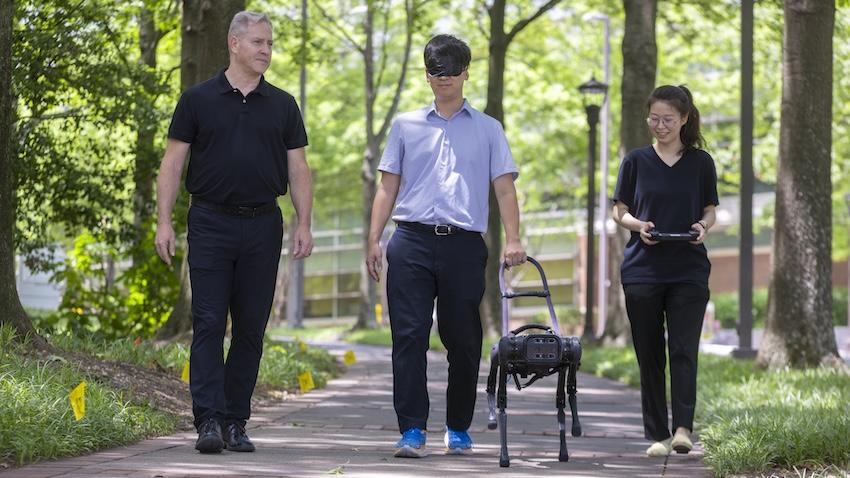
Georgia Tech Team Designing Robot Guide Dog to Assist the Visually Impaired
People who are visually impaired and cannot afford or care for service animals might have a practical alternative in a robotic guide dog being developed at Georgia Tech.
Before launching its prototype, a research team within Georgia Tech’s School of Interactive Computing, led by Professor Bruce Walker and Assistant Professor Sehoon Ha, is working to improve its methods and designs based on research within blind and visually impaired (BVI) communities.
“There’s been research on the technical aspects and functionality of robotic guide dogs, but not a lot of emphasis on the aesthetics or form factors,” said Avery Gong, a recent master’s graduate who worked in Walker’s lab. “We wanted to fill this gap.”
Training a guide dog can cost up to $50,000, and while there are nonprofit organizations that can cover these costs for potential owners, there is still a gap between the amount of available guide dogs and BVI individuals who need them. Not all BVI individuals are able to care for a dog and feed it. The dog also has fewer than 10 working years before it needs replacement.
Gong co-authored a paper on the design implications of the robotic guide dog that was presented at the 2025 International Conference on Robotics and Automation (ICRA) in Atlanta in May.
Before launching its prototype, a research team within Georgia Tech’s School of Interactive Computing, led by Professor Bruce Walker and Assistant Professor Sehoon Ha, is working to improve its methods and designs based on research within blind and visually impaired (BVI) communities.
“There’s been research on the technical aspects and functionality of robotic guide dogs, but not a lot of emphasis on the aesthetics or form factors,” said Avery Gong, a recent master’s graduate who worked in Walker’s lab. “We wanted to fill this gap.”
Training a guide dog can cost up to $50,000, and while there are nonprofit organizations that can cover these costs for potential owners, there is still a gap between the amount of available guide dogs and BVI individuals who need them. Not all BVI individuals are able to care for a dog and feed it. The dog also has fewer than 10 working years before it needs replacement.
Gong co-authored a paper on the design implications of the robotic guide dog that was presented at the 2025 International Conference on Robotics and Automation (ICRA) in Atlanta in May.
Recent Stories

New AI Models Could Create More…
Thursday, September 3, 2026
Professor Emeritus Named Distinguished Educator…
Tuesday, September 1, 2026
Incoming Professor Envisions World of…
Monday, August 31, 2026